

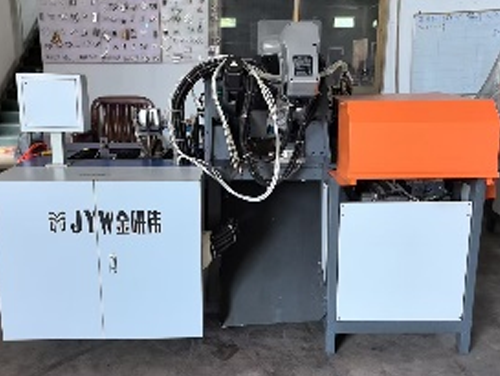
Expansion Angle Bracket Machine Cost-Benefit Analysis
Industry Background and Market Demand
Expansion angle brackets are critical structural components used in construction, industrial shelving, and modular assembly systems. Their primary function is to reinforce joints, ensuring stability under load. The demand for high-quality brackets has surged due to the growth of prefabricated construction and automation in manufacturing.
To meet this demand, manufacturers rely on expansion angle bracket machines, which automate the production of these components with precision and efficiency. The cost-benefit analysis of such machinery is essential for businesses evaluating capital investments, as it directly impacts production capacity, labor costs, and long-term profitability.
Core Technology and Functionality
An expansion angle bracket machine is a specialized piece of equipment designed to bend, punch, and form metal sheets into standardized brackets. Key processes include:
- Precision Bending – Uses hydraulic or servo-electric systems to achieve accurate angles (typically 90° or custom degrees).
- Punching and Notching – Creates holes or slots for bolts and fasteners.
- Automated Feeding – Ensures consistent material input, reducing manual handling errors.
Advanced models integrate CNC (Computer Numerical Control) systems, allowing programmable adjustments for different bracket specifications. This flexibility is crucial for manufacturers handling diverse client requirements.
Product Structure, Materials, and Manufacturing Process
1. Machine Structure
A standard expansion angle bracket machine consists of:
- Frame & Base – Heavy-duty steel construction for vibration resistance.
- Bending Unit – Hydraulic or servo-driven arms for angle formation.
- Control Panel – User interface for setting parameters (thickness, angle, hole placement).
2. Material Compatibility
Most machines process:
- Mild Steel (1–6 mm thickness) – Common for industrial applications.
- Stainless Steel – Used in corrosive environments.
- Aluminum – Lightweight but requires precise tooling to avoid deformation.
3. Manufacturing Process
The production sequence involves:
1. Material Loading – Coiled or sheet metal is fed into the machine.
2. Cutting & Punching – Blanks are shaped and perforated.
3. Bending – The metal is formed into the final bracket geometry.
4. Quality Inspection – Automated sensors or manual checks verify dimensions.
Key Factors Affecting Performance and Quality
Several variables influence the output quality and operational efficiency:
- Tooling Precision – Worn or misaligned dies cause dimensional inaccuracies.
- Material Consistency – Variations in metal thickness or hardness affect bending results.
- Machine Rigidity – Weak frames lead to deflection, reducing repeatability.
- Automation Level – Semi-automatic vs. fully automatic systems impact labor costs.
Supplier Selection and Supply Chain Considerations
When sourcing an expansion angle bracket machine, buyers should evaluate:
1. Technical Support – Does the supplier provide installation, training, and maintenance?
2. Customization Options – Can the machine be adapted for unique bracket designs?
3. Lead Time & Logistics – Importing heavy machinery may incur delays and additional costs.
4. After-Sales Service – Availability of spare parts and troubleshooting assistance.
Reputable manufacturers often offer turnkey solutions, including machine setup and process optimization.
Common Industry Challenges
Despite automation advantages, several pain points persist:
- High Initial Investment – Advanced CNC machines require significant capital.
- Maintenance Complexity – Hydraulic systems need regular servicing to prevent leaks.
- Material Waste – Inefficient nesting during cutting increases scrap rates.
- Skilled Labor Shortage – Operators must understand both machine programming and metallurgy.
Applications and Case Studies
1. Construction Sector
Prefabricated steel structures rely on expansion angle brackets for quick assembly. A European manufacturer reduced labor costs by 30% after switching from manual bending to an automated machine.
2. Warehouse Shelving
A U.S.-based logistics company improved production speed by 40% using a servo-electric machine, ensuring uniform bracket quality for heavy-duty racks.
Current Trends and Future Developments
1. Energy Efficiency – Newer models incorporate regenerative drives to reduce power consumption.
2. IoT Integration – Real-time monitoring of machine performance via cloud-based analytics.
3. Hybrid Machines – Combining laser cutting with bending for all-in-one processing.
FAQ Section
Q: How long does it take to recoup the investment in an expansion angle bracket machine?
A: Payback periods vary but typically range from 1–3 years, depending on production volume and labor savings.
Q: Can one machine handle multiple bracket designs?
A: Yes, CNC-enabled machines allow quick tooling changes for different geometries.
Q: What maintenance is required for optimal performance?
A: Regular lubrication, hydraulic fluid checks, and calibration of bending arms are essential.
Conclusion
Investing in an expansion angle bracket machine involves balancing upfront costs against long-term efficiency gains. By evaluating machine capabilities, material compatibility, and supplier reliability, manufacturers can optimize production while maintaining competitive pricing. As automation and smart manufacturing advance, these machines will play an increasingly vital role in structural component fabrication.
यह वेबसाइट यह सुनिश्चित करने के लिए कुकीज़ का उपयोग करती है कि आपको हमारी वेबसाइट पर सर्वोत्तम अनुभव मिले।
 English
 ไทย
ไทย Tiếng Việt
 বাংলা
বাংলা



 टेलीफ़ोन
टिप्पणी
(0)